
Crisis in Tumaco, Colombia – Piedad
Most of you will remember Piedad – our friend/patient from Colombia who spent six months with my twin sister, Susan, in Florida receiving treatment for her congenital lymphedema and elephantiasis.
Piedad is back in her home town of Tumaco, Colombia with her daughter, Susan. This past week the Colombian guerrilla used explosives to damage an oil pipeline. This caused spillage of over 410,000 gallons of crude oil, which has made its way into the Mira River. The Mira River is the source that supplies the aqueduct which provides potable water to Tumaco. The oil spill has forced the closure of the aqueduct – leaving over 160,000 people without potable water.
It is estimated that Tumaco will need over 600,000 liters of water daily to provide for its population.
I spoke with Piedad today, and the water tankers have not arrived to her neighborhood yet. Piedad is still having to wrap her legs daily – and imagine the difficulties of not having access to water. We have invited Piedad to come spend some time with us at the Clinic. Her daughter, Susan, is now in school, but is just beginning a two week vacation. Hopefully she will be able to come to San Lorenzo later this week. Because of Susan’s schooling, I don’t know how long they will be able to stay, but we would be happy to have them here on a long-term basis.
Please pray for Piedad’s situation – and the crisis through which the entire population of Tumaco is passing.
If you are able, and are interested in helping Piedad, please consider helping us with the cost of her travel.
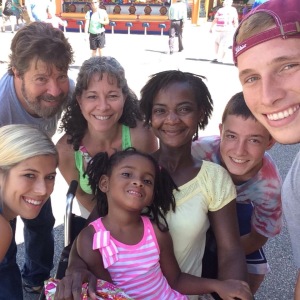
Piedad and Susan in Florida in 2014
Thank you!
Jane
I COULD USE YOUR HELP!
I could use your help! We are thrilled to have started our women’s club again. We have a group of approximately 30 women who meet once a week at the Clinic. A few of them are Christians – most of them are not.
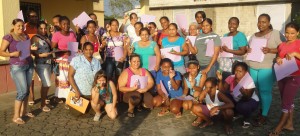
The ladies of our women’s club
They spend the first part of their time together in Bible study – and then enjoy working on some kind of craft activity. Currently they are doing a basic evangelistic study, learning about salvation and the person of Jesus Christ. Many of them were excited to receive their first Bible as a gift from us at the Clinic. I have been helping Maria Luisa and Angelita come up with ideas for their craft activities – but I am running out of ideas!
Would you help me? I need some ideas for crafts and other fun activities we can do with the women. I would welcome your ideas and input! Please let me know if you can help. We have a small budget for supplies, and would love to try new things! Feel free to contact me by Clicking Here.
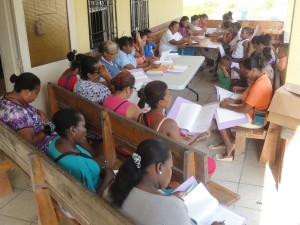
Bible study at our women’s club
PIEDAD AND ABIGAIL ARE COMING!
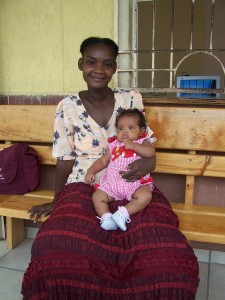
Piedad and Abigail in March 2010
Things are coming together! We have more good news. Piedad’s daughter, Susan Abigail, has also received her visa, and will be coming with Piedad to the United States. Abigail turned four in December, and it would have been very difficult for Piedad to leave her in Colombia for the several months that she will need to be in the States for her medical care.
Now that their visas are in hand – we have been able to plan travel dates. Piedad and Abigail will be traveling to Florida in late February!
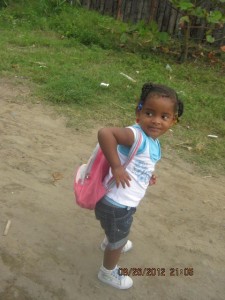
A more recent picture of Abigail
Although Piedad is coming to the United States to receive treatment for her lymphedema – we want to make sure to show her our finest American hospitality! If you would like to help us make Piedad’s and Abigail’s time in the United States special – let us know! You can contact me at scifrespletcher@yahoo.com.
If you would like to contribute to Piedad’s care while she is in the United States, please click the button, below.
GREAT NEWS!
I have some great news to share! Many of you will remember Piedad Batalla. She is the young Colombian woman who we initially met in February of 2008. She has lymphedema praecox – which had reached the severe stage of lymphostatic elephantiasis.
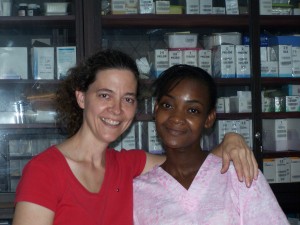
Piedad and me at the Clinic
My twin sister – Susan – is a physical therapist with specialty training in the treatment of lymphedema. God does work things out perfectly – doesn’t He? We made an effort to treat Piedad’s lymphedema with repeated visits from Susan over a period of about two years – and we made great progress. Piedad lost over 100 pounds, and her physical condition was greatly improved. Unfortunately we were never able to complete her treatment – to achieve the maximum improvement that we know is possible in her case. Although Piedad did a great job with self-treatment with the techniques Susan taught her – it just wasn’t enough, considering the severity of her condition.
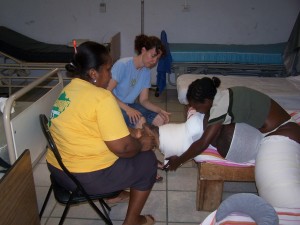
Susan treating Piedad in 2008
We tried to get Piedad a visa so that she could travel to the United States and finish her treatment – but we were unsuccessful. Now – a Colombian physician has taken interest in her case, and he, along with various colleagues, have been able to help Piedad obtain a visa for her medical treatment!
Piedad and Susan are now deciding when would be the best dates for her to travel. We have a lot of details to work out – but we are thrilled that this dream has become a reality!
If you have questions about Piedad’s care, or would like to know how you can help – drop me a note at scifrespletcher@yahoo.com
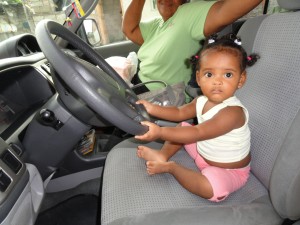
Piedad’s daughter, Susan Abigail
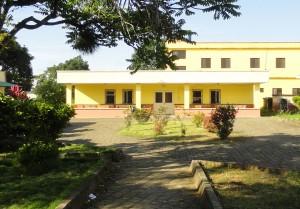
The San Lorenzo Clinic
As many of you know, we are in the process of raising funds for our new hospitalization area and emergency room. So far, we have approximately half of what we need for our construction project.
One of our supporters has just offered to match every donation made before the end of the year to the Clinic’s construction fund – up to $20,000.00!
So – we have the chance to double our money! Would you consider helping us take advantage of this offer?
Thank you!
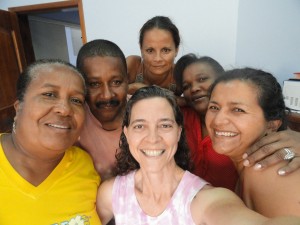
San Lorenzo Staff
Please Pray!
We are excited about our plans to build a new hospitalization area at the Clinic. As we prepare for the construction project, one of the needs we have is additional equipment for the new building.
We have been working with Supplies Over Seas (SOS), an organization based in Louisville, Kentucky which helps distribute medical equipment to health care facilities all over the world. SOS will be sending us a 40 foot container filled with medical equipment and supplies. It has been a long process, but we are almost ready to have the container shipped.
We will be receiving many different pieces of equipment. One of the most important items will be beds for our new hospitalization area. The beds that we use currently are in terrible shape, and it is a bit embarrassing for us to have to put our patients in such poor quality accommodations.
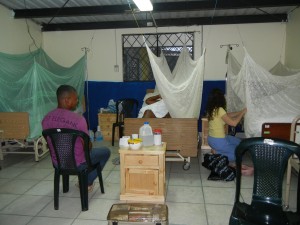
Our current post-op ward
We will be receiving hospital beds, a labor and delivery bed, monitors, operating room lights, anesthesia machines and more.
HERE IS WHERE WE NEED YOUR HELP. Tomorrow (Monday, September 23, 2013) our customs agent here in Ecuador will be turning in our documents requesting that Ecuador allow our container to be brought into the country, and that it may be brought in with tax exempt status. PLEASE HELP US PRAY that we might find favor with the officials in Ecuadorian customs who will be responsible for evaluating our request, and that this process might go smoothly and quickly. It is possible that we may be required to ask for special permission for some of the supply items – and if this happens the process could be quite lengthy. Customs has occasionally been unpredictable, so we are not sure how the process will play out. In the best of situations, our agent says that we could have permission as quickly as one week.
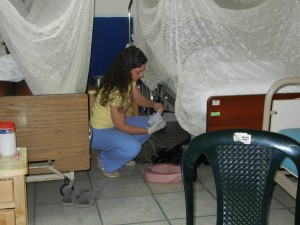
Attending to a patient in our current post-op area
THANK YOU for your support and your prayers! We will let you know how things progress!
ERCP (or not) for Nancy…
Prior to our operations in July, Nancy Escobar came to see me for pain in her upper abdomen on the right side. (For those of you who know Nancy Ferrin, Gonzalo´s wife – this is not she – this is a different Nancy). The source of her pain was not difficult to diagnose, she was having gall bladder problems – and it needed to come out.
At the time of her operation, we found that Nancy also had Mirizzi’s syndrome – a condition where part of the gall bladder or its duct causes obstruction of the main bile duct. This made her operation more difficult and left me with a decision to make. The decision was whether or not to open her bile duct and explore it for another source of obstruction (a stone). As it appeared that the obstruction had been caused by the gall bladder and its duct – I felt that removing her gall bladder would relieve the obstruction and an exploration of the duct was not warranted. I decided to follow her closely after surgery, and should she show signs of an obstructed bile duct, we would obtain an ERCP (an endoscopic, and less invasive method of removing stones from the bile duct) to remove the stone(s). In our earlier years I never would have considered this, as it was extremely difficult to obtain an ERCP. Now, ERCP is more readily available, and we have a gastroenterologist colleague in Quito who is available to help us with such patients.
I saw Nancy back one week after surgery. She looked good and was having much less pain. One week later, however, was a different story. Her eyes were a bit yellow, her skin itched – and a lab test showed that likely had a stone in her main bile duct. We called our gastroenterologist and made plans for her to travel to Quito that night to have an ERCP the next morning. That was last Wednesday – and since then it has been nothing less than a constant headache.
Because of some bleeding tests that were abnormal, our gastroenterology colleague didn’t want to proceed with the ERCP. Nancy was then transferred to a large government hospital in Quito, and plans were made to perform the ERCP the next day. That was four days ago – and Nancy still has not undergone her ERCP.
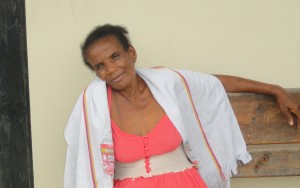
Nancy – two weeks after her gall bladder operation
It can be difficult to navigate the system in the government hospitals. Every patient needs a family member to accompany him – in order to help obtain blood work, do paperwork, obtain other exams… Loida (one of our employees at the Clinic) is in Quito and has been helping Nancy and her daughter-in-law wade through all of these requirements. In theory, the care in the government hospitals is free. But some medicines are not always available, and they must be bought outside the government system. Also, Nancy and her daughter-in-law are from the coast, where the weather is hot and humid. They are not accustomed to the cool weather in Quito, and neither do they have appropriate clothing for the climate there. So we have bought them some warmer clothing for their stay in Quito.
We are hoping that sometime this week Nancy will get her ERCP. I will post an update later this week to let you know how her situation is progressing.
Gunshot…..
As most of you know, San Lorenzo is considered by most people to be a fairly dangerous place. We are known for having high levels of crime, violence and murder. But we have been very blessed at the Clinic – we have not had problems with violence inside the Clinic or on our property. We did have a bit of a scare a couple weeks ago – BUT – it was at our office in Quito!
Years ago, when I came to San Lorenzo to live, we converted my apartment in Quito into an office for our Ecuadorian foundation that runs the Clinic. I still have living space there, and stay there when I am in Quito. This is where Dámarys and Loida work while they are in Quito.
Two weeks ago, Dámarys was alone in the office on a Friday afternoon. She was working in her second floor office. She heard a loud gunshot and then glass breaking inside the apartment. It sounded quite close. She waited, and after some time passed with no further activity – she went up to the small room that comprises the third floor of the apartment. There she discovered a three inch hole in the window and shattered glass on the floor. She could see where the bullet had passed through an adjacent cardboard box that held medical supplies.
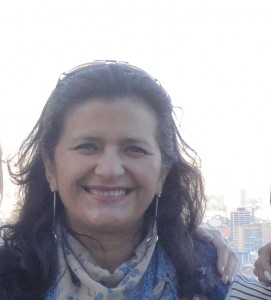
Dámarys Reyes, the Clinic’s administrative director
Soon after she heard sirens, and the police showed up at the construction site next to the office. Apparently it had been payday for the construction workers, and while they were receiving their pay someone tried to rob the workers – and gunshots were fired during the altercation. It was a stray bullet that found its way to the third floor of our office.
We are thankful that Dámarys was not injured, and that she had not been on the third floor when the bullet entered the office.
And they say that San Lorenzo is dangerous….!!!
WATER….
We are very thankful for the wonderful well that we have at the Clinic. The well was dug in 2006, and since then we have had a reliable source of water – even during our dry seasons. We have had some challenges with the submersible pump – but we are still very blessed to have a consistent water supply.
The Clinic has two water pumps. One is a submersible pump that is 200 feet underground in the “new” well. The second is an above-ground pump that can be used to either pump water from the “old” well, or from our cistern. The cistern can be filled by either of the two pumps from each one’s respective well, and also receives rain water that we collect from the roof of the Clinic’s guesthouse.
This past week both of our pumps stopped working. That means that we are unable to retrieve water from our deep, reliable well. We will be able to use the water in our cistern, we just are not able to pump it out. So, we have resorted to getting water of the cistern by siphoning, and carrying water in buckets. We will now be dependent on rain water to keep our cistern full, but unfortunately we are now entering the dry season in San Lorenzo.
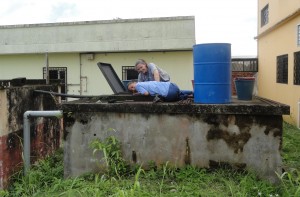
Carmen and I siphoning water from the cistern
So for now – we have no running water at the Clinic. It’s not too bad for the issues of daily living, it just means baths out of a bucket and flushing toilets the old fashioned way. But it’s a bit more labor intensive for the work at the Clinic. Water must be carried to each exam room, and it makes our laundry issues a bit more difficult.
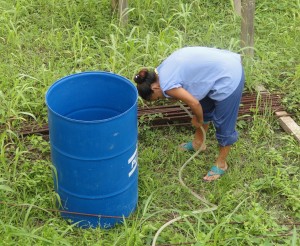
Carmen siphoning water into a 55 gallon tank
There are certainly people that can come help us with our pump problems. But pulling up our submersible pump is not a simple task, and not an inexpensive one. Karl and Jody Needy (of Newport, Tennessee) have been our pump experts over the past three years, and have performed all our pump maintenance on a yearly basis. They will be back at the Clinic in about a month – and so we will most likely wait for them to arrive to fix our pump problems. So for the next month we will be using buckets and siphoning hoses – and praying for rain!
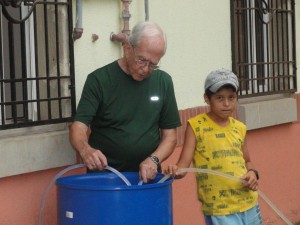
Papi Don and Cristian manning the water tanks
Building Project
Over the past 10 years the surgical services that we offer at the Clinic have expanded greatly. We have gone from simple procedures done under local or regional anesthesia (small “lumps and bumps,” uncomplicated hernias, tubal ligations) to complicated cases requiring regional or general anesthesia (gastrectomies, prostatectomies, hysterectomies, thyroidectomies, etc.). Our patient quarters, however, have changed very little over those same 10 years. We have two post-operative rooms, each about 225 square feet, one for men and one for women. Each room houses up to five patients, but they are in a separate building from our clinical services, and we have no nurses station or space for monitoring equipment. The Ecuadorian Ministry of Health is not satisfied with our current facilities either, and not only must we improve our hospitalization area, we must also add on a small emergency room.
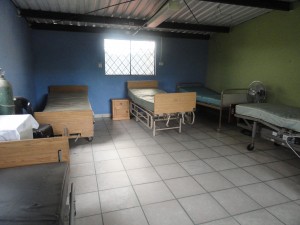
Our current post-operative ward
We are currently putting the final touches on the floor plans for the building – and we hope to be able to start construction this August. We are excited to finally be moving forward with the construction – this has been a dream of ours for several years.
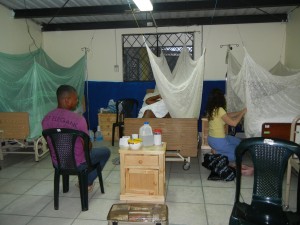
Patients in our post-op ward
We are currently raising the funds we will need for the hospitalization area and the emergency room. Would you consider helping us with the cost of the building? We will need about $400,000.00 to complete the project. Any donation, big or small, will help us meet our goal.
We will use thousands of cement blocks during the construction of our new building. Adding in the other costs of construction, we have estimated that each cement block will cost approximately $10.00. I would like to ask you to consider helping us raise the funds for 1 block, 10 blocks, 100 blocks or 1000 blocks! If you can help with one block – that would be awesome! And if you can help us raise the funds for 100 or 1000 blocks – that would be awesome as well!
We will keep you up to date on how our preparations are going. Thank you so much for your continued support!
